

How a Patchwork Adelaide Coven Found Its Place in the World
Ancient Patterns for Modern Souls

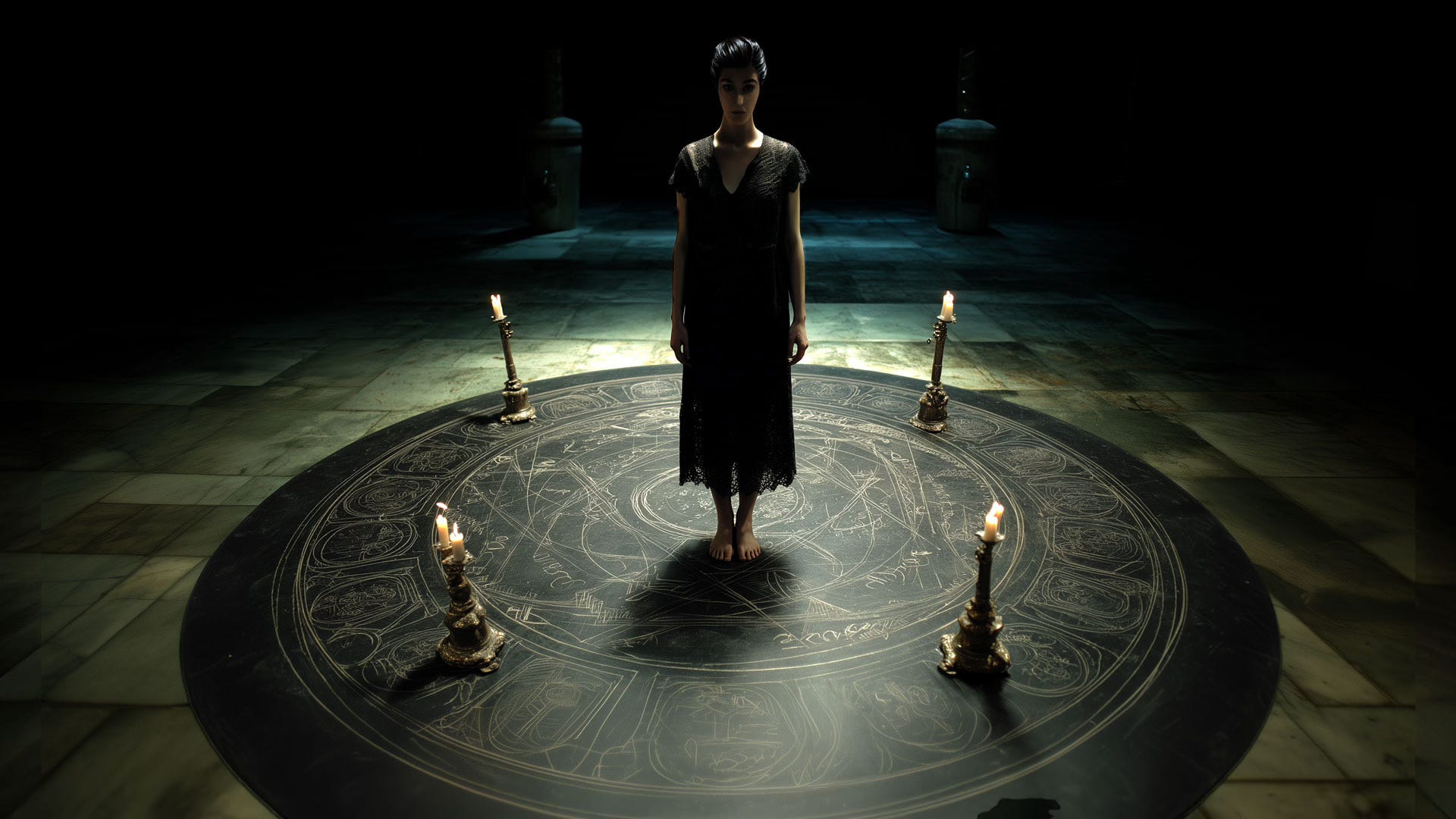
Adelaide’s Coven of Witches
We called ourselves Earth Circle. Not a grand title, but an honest one.
We wanted to create an enduring working coven of witches.
Back in Adelaide, in the early ’70s, there were no hashtags, no podcasts, no TikToks to tell you you weren’t alone in your magick. If you wanted to find other Witches, you had to resort to Magick and cast your intentions into the world with ritual, sometimes with sheer willpower and a little synchronicity.
That’s exactly what I did.
One warm autumn evening, in my room as a makeshift temple, I cast a spell—not for love or money, but to find kindred spirits. It was 1972, and I was almost 18 years old. I opened my heart, asking the gods for the companionship of other witches. Lit by candlelight, I chalked a circle on the bare floorboards and whispered my incantations to the Moon. "At the rising of the Moon, may the Witches find me!" And not just find me, but join me on this path.
A month later, I had a new job and had moved house to North Adelaide. Then an unlikely work connection introduced me to Christine, who preferred to be called Chris. She was a P.A. for a small firm, but soon there were others—an Antique dealer who had an eye for old ceremonial tools. A police officer with a penchant for metaphysics. A university student with a tarot deck hidden in his denim jacket. But it was Chris, a natural psychic, who would help me create the foundations for a real working coven. Of course, later there would be others—Morgan, a teacher of Italian, who helped me elevate the rituals we were developing. The gypsy witch named Anatha Wolfkeepe. And Zac—ever the charmer—who would go on to seed many other covens like pomegranates in Persephone’s pocket. And Gillian, who held the space for the depth and immersion into a rite to invoke the sacred Shakti.
IN THE NEWS: Early on, our fledgling coven agreed to be interviewed by The News, an Adelaide newspaper. We came out of the broom closet firing with enthusiasm. If not, despite our innocence, or because of it, the media treated us with respect. "There was Tim Hartridge, 18...he is a lanky young man with sweeps of long hair and a ready smile...he looks intelligent and speaks intelligently." This was our chance to respond to an earlier anti-Witchcraft article the paper had run a couple of weeks prior. That pro-Christian article had nothing but dire warnings for the young about involvement with the Occult, but we were the young! And for many our age, that 'occult' ship had well and truly sailed. Our desire to explore the psychic reality was a search for soul-felt meaning, especially in the psychic experiences we were having. Not surprisingly, we had found an alternative—neo-pagan spirituality, and Wicca in particular—we were riding that first wave of a Witchcraft revival in Australia.
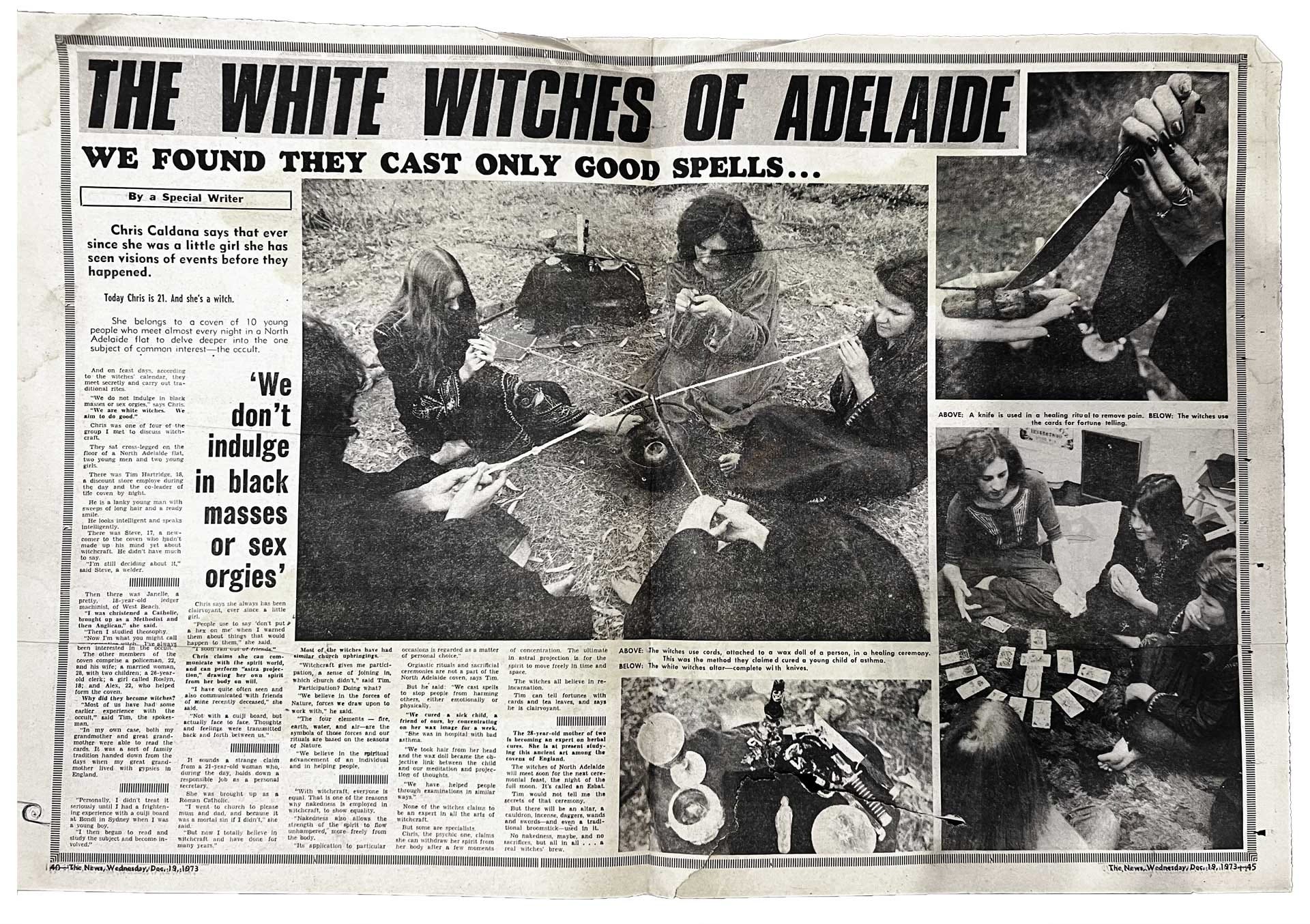
We called ourselves Earth Circle. Not a grand title, but an honest one. We wanted to create an enduring working coven of witches.
It wasn't just the rituals or the research that made it magickal—our deep longing for kindred spirits had led to a convergence of unlikely individuals. We had one thing in common: a beautiful hunger for meaning, for the myths, and for the Moon. It was the kind of hunger that inspired. That enabled us to reimagine. And rebuild a practice of Witchcraft that suited our Southern stars and in our beloved Antipodean soil.
And it was that same hunger that led me one day to a curious, recurring number: 108. And it has a curious significance with the Witches' ritual Cord.
Enter The Witches' Cord
In Wicca, the Cord is one of the sacred tools. Often overlooked. But to me, it whispered secrets. We used it, of course, in rituals of binding, but we also used it to mark out the Circle. The father of modern Wicca, Gerald Gardner, discussed using the Witches' Cord in a manner that seemed quite unusual to me.
Gardner says, the ritual Cord—often referred to as the cingulum—is one of the eight core ritual tools in Wicca (that much I understood). He then went on to describe the Cord as being traditionally made of natural fibres and notes that its length is typically nine feet. He says, the nine-foot cord is used specifically for marking the sacred circle for rituals—and here is where it gets strange—he insists the Witch will usually fold or loop the Cord in half to measure the diameter of a nine-foot Circle!
This begs the question, "Why not use a Cord that is four-and-a-half feet in length to start with?
In contrast, here is what I was doing.
I stretched my nine-foot Cord to its full length, pegging it at the centre of my ritual space by the Sword or Athamé. From this, I scribe a perfect Circle of 18 feet in diameter. Simple! And besides, an 18-foot Circle is a much better size for a whole coven of Witches—a nine-foot Circle is an exceedingly cramped space. Try it, if you don't believe me!
Then late one night—I swear I could hear the Moon breathing—at that moment I was standing beneath a big and bright full moon, as I continued to wonder about this measurement of the Cord—Why nine feet?
Now, my dear witches, here’s where it gets delicious. As a youngster, I had a telescope, and you could find me outside most nights, weather permitting, literally star-gazing. Naturally, I was very familiar with the Moon. And I knew its size was some 2,160 miles in diameter. And then the proverbial penny dropped. The radius of the Moon is 1,080 miles!
In a ratio scale of 10 miles equalling 1 inch, this gives us 108 inches, or 9 feet—the same length as the Witches' Cord! When you trace a Circle using the full length of the Cord, you are creating a temple of literally lunar proportions! Had Gardner not realised this? Why had others after him not talked about this?
I think, and it is only my opinion, the British Witches don't practice their rituals outdoors as often as they might—otherwise, I'm sure they would have seen this connection. Yes, the nights get chilly in Britain, and the skyclad rituals, it seems, are a less comfortable option compared to our Aussie counterparts.
I realised then—like an arrow bolt from Diana’s bow—that when we cast the Circle using the full measure of the Witches' Cord, we are not just making a sacred space. We’re recreating a lunar temple that is literally buzzing with the astral energy of the Moon. Every Witch Circle becomes a Temple of the Moon if you use the Witches’ Cord to demarcate a radius of 108 inches or a 216-inch diameter. Our Circles became a perfect ratio of the Moon.
It gave me gooseflesh. And I knew I had to share it.
There are many interesting facts about the number 108, which is why I think it isn’t arbitrary. It hums across cultures and ages: 108 beads on a mala (a Hindu rosary). There are 108 names of the Goddess* in Hindu culture. 108 nadis converge at the Anahata (heart) chakra in yoga. Even astronomically, the Moon is about 108 times its own diameter away from Earth.
* In Hinduism, many major deities have collections of 108 names, known as Ashtottara Shatanamavali (literally, “a hundred and eight names”). These lists are recited for worship, meditation, and ritual purposes. For example, Goddess Durga is widely honored with 108 names, each reflecting a different aspect or attribute of her divinity. Other goddesses such as Lakshmi and Saraswati also have their own 108-name lists. The number 108 is considered highly auspicious in Hindu tradition, in part because it symbolise completeness.
Other Significance to 1·0·8
The number 108 holds deep significance across a number of spiritual, religious, and scientific traditions—while its individual digits (1· 0 · 8)—also carry symbolic meanings. Let’s take a survey of these:
Spiritual and Cultural Significance of 108
In Hinduism, Buddhism, and yoga, the number 108 is considered an auspicious and sacred representation of wholeness, cosmic order, and spiritual completion. For example, malas (prayer beads) typically have 108 beads, and mantras are often chanted 108 times.
There are 108 Upanishads (ancient Indian philosophical texts), 108 sacred sites (Shakti Pithas in Tantra) in India, and 108 energy lines (nadis) said to converge at the heart chakra.
In Buddhism, there are 108 defilements that one must overcome to achieve enlightenment.
Mathematical and Numerological Aspects
108 is a Harshad number, meaning it is divisible by the sum of its digits (1+0+8=9; 108/9=12).
In numerology, 108 reduces to 9, which symbolises completion, unity, and spiritual attainment.
The number 108 appears in various mathematical relationships, such as 12 (zodiac signs or houses) times 9 (planets in Vedic astrology).
The number 108 is also significant in astrology and astronomy: the average distance from the Earth to the Sun is about 108 times the Sun’s diameter, and similarly, the distance from the Earth to the Moon is roughly 108 times the Moon’s diameter.
Symbolism of the Individual Digits
1: Represents beginnings, creation, leadership, and stepping into new situations with courage.
0: Symbolises potential, eternity, completeness, and amplifies the qualities of other numbers it appears with.
8: Associated with power, abundance, self-confidence, and the ability to manifest desired outcomes.
Other Interesting Connections
In yoga philosophy, it is said that there are 108 sacred points on the body.
The Sanskrit alphabet has 54 letters, each with masculine and feminine forms; 54 x 2 = 108.
The number 108 is seen as a bridge between the microcosm and macrocosm, symbolising the unity of the individual with the universe.
The Mark of the Witch
The jewel in this witch’s pointy hat was that the one symbol that has come to represent modern Pagan Witchcraft generally is the Pentagram, and this too has 108 in its measure, with an outside angle of 108°.
A profound revelation lies within the quintessential symbol of Witchcraft—the Pentagram. Its external angles measure precisely 108 degrees, an elegant geometric echo that inexorably binds this ancient Craft to the sacred number that resonates with the Moon and forms part of the golden ratio*. This mathematical harmony serves as both validation and revelation: the very emblem chosen to represent modern Pagan Witchcraft carries within its lines the same divine proportion found throughout nature's grand design.
*When you draw a pentagram, the lengths of the segments that make up the star can be divided in such a way that the longer segment divided by the shorter segment approximates the golden ratio, φ (about 1.618). This intrinsic relationship demonstrates how the golden ratio not only manifests in the dimensions of the Pentagram but also contributes to its overall aesthetic appeal, aligning with human perceptions of beauty and harmony.